Reference Guide to the Talmud: The Indispensable Talmud Study Aid by Adin Steinsaltz
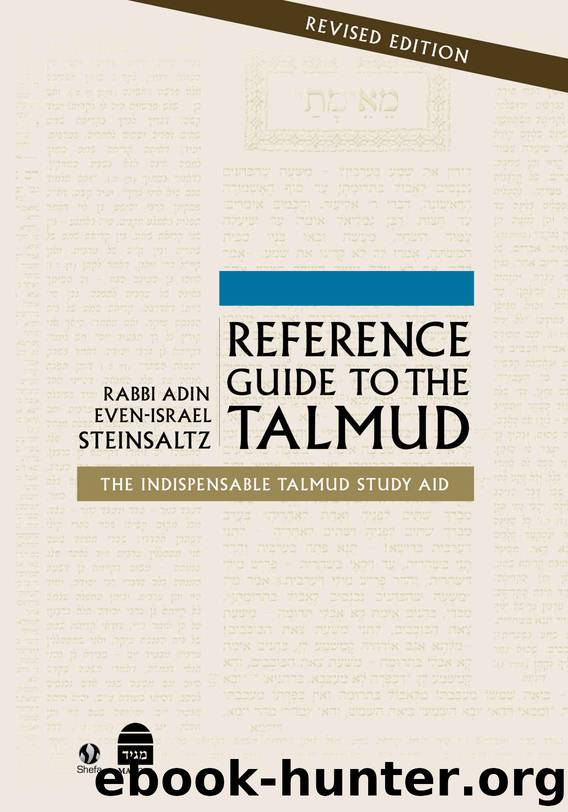
Author:Adin Steinsaltz [Steinsaltz, Adin]
Language: eng
Format: azw3, epub
ISBN: 9781592643127
Publisher: Koren Publishers Jerusalem
Published: 2014-05-20T04:00:00+00:00
Folded and tied document – גֵּט מְקוּשָּׁר. Most commonly a bill of divorce used by priests. In contrast to a regular document, this document was folded several times and sewn at the folds. At least three witnesses were required for this bill of divorce and one witness signed on the outer side of each fold. The original purpose of this elaborate procedure was to delay a hasty decision by a priest to divorce his wife and allow him time to reconsider before making an irrevocable decision, as a priest who divorces his wife is not permitted to remarry her.
Bare bill of divorce – גֵּט קֵרֵחַ. A folded and tied document (see previous entry) that was invalidated because it lacked a sufficient number of witnesses. This could occur when one of the folds of the bill of divorce was not signed by one of the witnesses.
For his sake and for her sake – לִשְׁמוֹ וְלִשְׁמָהּ. The Torah requires that a bill of divorce be written with the specific intention of effecting a divorce between the two marriage partners. It must be written specifically for the husband and specifically for his wife. A bill of divorce that is not written with this intention, even though it contains the correct names of the husband and the wife, e.g., a bill of
divorce written for another couple bearing the same names, cannot be used in divorce proceedings.
Substitute names – כִּינּוּיִים. Often, in addition to the name by which he is commonly known, a person may have additional names. In certain cases, i.e., writing a bill of divorce, these supplementary names are halakhically
significant. If he wrote a bill of divorce in which these names were not included, it is invalid.
They coerce him until he says “I want to…” – כּוֹפִין אוֹתוֹ עַד שֶׁיֹּאמַר רוֹצֶה אֲנִי. Some actions, e.g., offering certain sacrifices, or giving a bill of divorce, can be effective only if they are performed with the consent of the person on whose behalf they are being carried out. If the person does not consent to these actions, the court will, in certain instances, apply pressure and at times even physical coercion to force him to consent.
Agent for delivery – שָׁלִיחַ לְהוֹלָכָה. An agent appointed to bring a bill of divorce from the husband to his wife. This agent assumes the legal status of the husband. When he gives the bill of divorce to the woman, the divorce is effected. The wife can also appoint an agent for receipt. This agent assumes the legal status of the wife, and when the bill of divorce reaches his hands the divorce takes effect.
Witnesses who observe the delivery of a legal document – עֵדֵי מְסִירָה. Specifically, with regard to the witnesses to the delivery of a bill of divorce, there is a difference of opinion among the Sages whether these witnesses or the witnesses whose signatures appear on the document are the witnesses who render the document effective.
It was written in my presence and signed in my presence – בְּפָנַי נִכְתַּב וּבְפָנַי נֶחְתַּם.
Download
Reference Guide to the Talmud: The Indispensable Talmud Study Aid by Adin Steinsaltz.epub
This site does not store any files on its server. We only index and link to content provided by other sites. Please contact the content providers to delete copyright contents if any and email us, we'll remove relevant links or contents immediately.
The Power of Habit by Charles Duhigg(3116)
Man's Search for Meaning by Viktor E. Frankl(2658)
Mckeown, Greg - Essentialism: The Disciplined Pursuit of Less by Mckeown Greg(2413)
MOSES THE EGYPTIAN by Jan Assmann(2406)
Devil, The by Almond Philip C(2321)
The Complete Dead Sea Scrolls in English (7th Edition) (Penguin Classics) by Geza Vermes(2268)
Unbound by Arlene Stein(2261)
I Capture the Castle by Dodie Smith(2026)
Schindler's Ark by Thomas Keneally(1864)
The Invisible Wall by Harry Bernstein(1794)
The Gnostic Gospel of St. Thomas by Tau Malachi(1778)
The Bible Doesn't Say That by Dr. Joel M. Hoffman(1673)
The Secret Doctrine of the Kabbalah by Leonora Leet(1600)
Political Theology by Carl Schmitt(1567)
The Jewish State by Theodor Herzl(1525)
A History of the Jews by Max I. Dimont(1515)
The Dead Sea Scrolls Bible by Martin G. Abegg(1500)
The Book of Separation by Tova Mirvis(1477)
Oy!: The Ultimate Book of Jewish Jokes by David Minkoff(1359)
